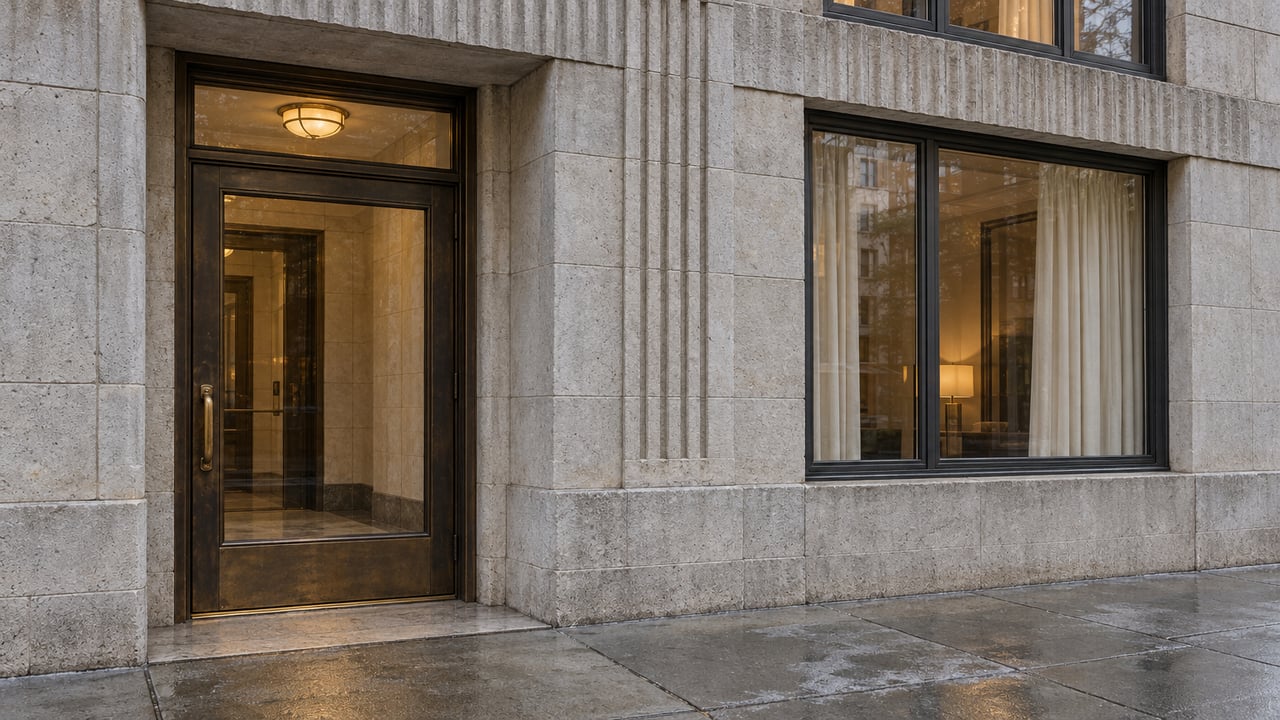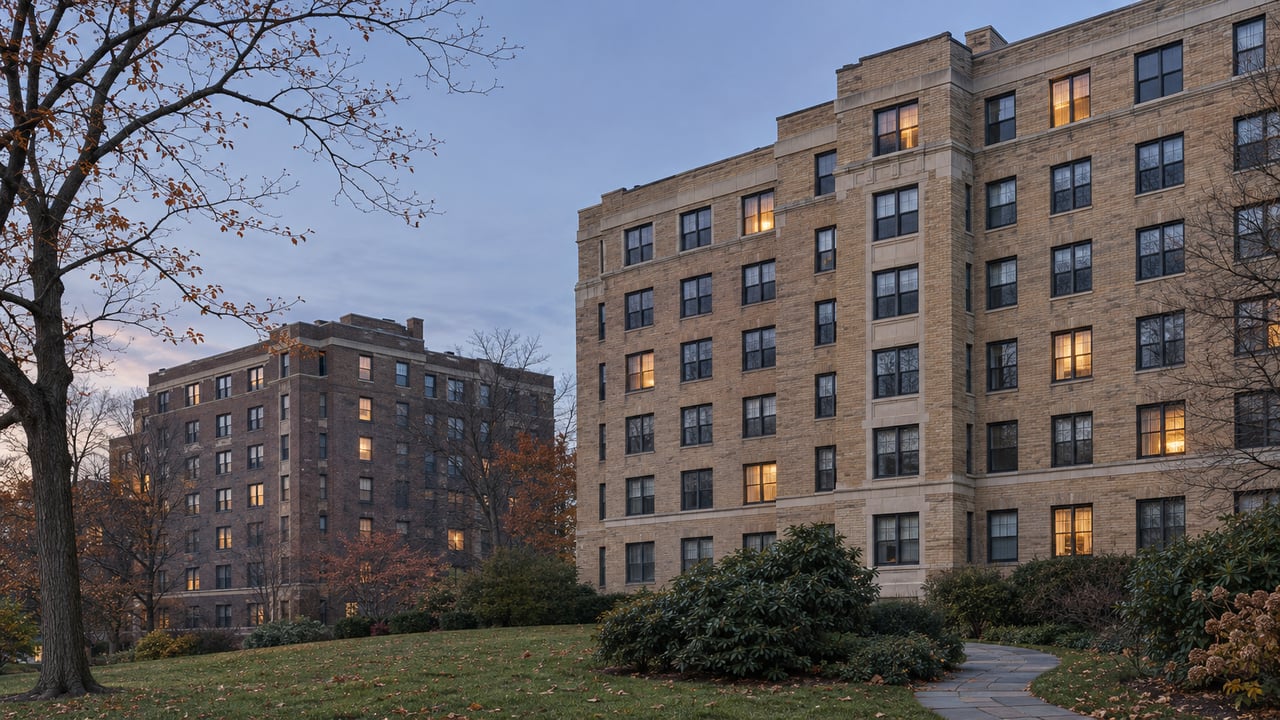
On October 13, about 20 residents and board members from co-ops around Riverdale met at the Whitehall, the co-op tower at 3333 Henry Hudson Parkway. City representatives were there to present "Cutting Carbon in Co-ops and Condos," a workshop from the Mayor's Office of Climate and Environmental Justice, Building Energy Exchange and the Council of New York Cooperatives and Condominiums, according to the Riverdale Press. The Whitehall's board president, Jeffrey Moerdler, described the garage roof under the pool deck, which he said "leaked like a sieve." To fix it, the building had to tear out the concrete and a row of brick cabanas. That cleared an almost 30,000-square-foot deck, and the board turned it into a green roof.
A buyer touring the Whitehall or any other Riverdale co-op this winter is buying into a building's repair calendar as well as an apartment. Boards across this neighborhood are paying for facade, roof and building-system projects now, and the costs reach shareholders through monthly maintenance or assessments. Two apartments with similar asking prices can sit at very different points in that cycle. For a buyer comparing Riverdale co-ops, the building is the first thing to compare.
The borough's co-op market gives buyers time to ask
Bronx co-op prices are rising slowly, and supply is still long. In OneKey MLS's Bronx County report for the third quarter of 2026, with data as of October 7, the co-op median sale price was $243,500. That was up 5.9% from the third quarter of 2025, and 134 co-ops closed, up 9.8%. In the same quarter, average days on market fell to 101 from 113, and inventory at quarter's end was 577 units. That works out to 10.9 months of supply, down from 12.8 a year earlier.
These are borough-wide numbers, not a Riverdale-only count, but the direction is useful. A market with close to 11 months of supply moves slowly enough for a buyer to read a building's financial statements, ask for board minutes and compare two or three buildings side by side. The cost of doing that homework is low right now. The cost of skipping it shows up in the monthly bill.
Where the repair bill lands
The Riverdale Press reported in June on a petition that began in a Fairfield Avenue co-op and asked Council Member Eric Dinowitz to support financial relief for co-op buildings paying for capital work. Another 230 people signed it. In a co-op, the paper noted, those costs reach shareholders as higher maintenance or as an assessment, which can be paid in a lump sum or over time.
The same story gives three figures from three Riverdale buildings. One Fairfield Avenue shareholder recalled paying $12,000 for brick facade work two or three years earlier. A board member at that building, Alan Charney, said it has a reserve fund but that assessments are still the most financially responsible way to pay for the work. A 1960-built co-op on Riverdale Avenue raised maintenance 12% last year, or $180 a month on a one-bedroom. A longtime shareholder there said the increase was partly for a mortgage refinancing and mostly for capital improvements. A shareholder at a 50-unit Independence Avenue co-op made the point about size: fewer units means each one carries a larger share of the same work.
Set those figures against the borough's price level. A $180 monthly increase comes to $2,160 a year, and over ten years it adds $21,600, close to 9% of the $243,500 Bronx co-op median for the third quarter. A $12,000 assessment is just under 5% of that median. In a market where entry prices are modest, the monthly side of the ledger is a large share of what ownership costs. A building's choices about how to pay for its repairs can matter as much as the negotiated price.
Two boards on the same parkway
At the October workshop, two buildings on Henry Hudson Parkway showed where in the cycle a building can sit. The Whitehall used a repair it had to make anyway, the leaking garage roof, as the point to add the green roof. Kathleen Carroll, vice president of the board at 3001 Henry Hudson Parkway, said her building's current energy work is already in hand. She also said rising insurance, heating and real estate tax costs have her planning further ahead, as the Riverdale Press reported.
Building Energy Exchange CEO Richard Yancey gave a framework that a buyer can use as well as a board. He said planning, financing and permitting can take years. He also said a long-term plan helps a building take advantage of "trigger events," such as "if a piece of equipment's getting near the end of its useful life, or if you have a refinancing coming up." For a buyer, the trigger events in a building's near future are where the large unknowns sit, and a building that has already gone through its own has fewer of them left.
Refinancing moves the number too
The Riverdale Avenue increase was partly about a mortgage, and a Norwood co-op a short drive east shows how much a refinancing can move maintenance. Habitat Magazine reported on 3520 Tryon Avenue, a 64-unit co-op. After a $2.2 million flexible-rate mortgage left it with $600,000 in reserves, the board cut a proposed 20% maintenance increase to 5%. When the building later refinanced, the lender asked for a 54% increase, and the board negotiated it down to 31%. The same building estimated its facade and window work at $1.25 million and paid for it with a seven-year assessment. It expected to recover $500,000 through J-51 and was seeking a $38,880 NYSERDA incentive.
Tryon Avenue is in Norwood, not Riverdale. It is still the clearest recent Bronx example of a building's debt and its repair schedule hitting the monthly charge at the same moment. When a co-op's underlying mortgage matures, the maintenance a buyer signs up for this year can change.
How an assessment shows up in a sale
Assessments are part of what gets negotiated between buyer and seller. Habitat Magazine reported in February 2025 that sale documents spell out whether the seller pays off the remaining balance at closing or the buyer takes it over and pays the installments.
One Spuyten Duyvil listing on the market in mid-November shows what this looks like in practice. A renovated three-bedroom, 1,800-square-foot corner unit at the Winston Churchill, 2500 Johnson Avenue, was asking $795,000. It carries $2,867 in monthly maintenance plus a special assessment of $653.18 a month that runs through February 2030, so the monthly total is about $3,520. The listing says the seller had reduced the price and would pay one year of the assessment, about $7,838, if the sale closes by the end of the year. Listing terms change, but the structure is the point. A seller covering part of an assessment is a form of price concession, and the buyer should count it as one.
Comparing Riverdale buildings side by side
Riverdale's co-ops run from the towers along Henry Hudson Parkway to smaller buildings on Independence Avenue, Fairfield Avenue and Riverdale Avenue. In this market, the way to compare them is by where each one sits in its capital cycle. These are the questions that separate one building from another:
- When did maintenance last rise, by how much, and was the increase for operating costs, debt or capital work?
- Is an assessment in place, how much is left, and when does it end?
- Which major projects are finished, like the Whitehall's roof, and which are still ahead?
- When does the building's underlying mortgage mature?
- How many units share the cost of the next project?
A lower asking price at a building with its largest projects still ahead may cost more over five years than a higher price at a building that has already paid for its work. The difference between co-op maintenance and condo common charges matters here, because maintenance carries the building's debt and taxes as well as its upkeep. Buyers weighing Riverdale against other parts of the borough may also find our look at Mott Haven's new construction and the Bronx neighborhood guide useful for context.
The maintenance, assessment and refinancing figures above come from published reports and listings with the dates shown. They are general information, not legal, tax or financial advice. Please confirm how any building's finances affect you with your attorney, accountant or lender.
If you're weighing two or three Riverdale co-ops this winter and want to talk through how their maintenance and assessment histories compare before you make an offer, Maria Nica is glad to start that conversation. Let's Connect.